Should you use Kajabi or Thinkific?
You’re probably considering launching your own online course and asking yourself this question. The great thing is that both course creation platforms offer a free trial so you can test them out for yourself before making a decision.
However, I’ve already tried both so if you want to know more about these two platforms, you can read this entire post where I compare them. Then you can decide which one you would like to build your business with.
Finding the right learning management system is very important especially if you’re just starting out. Kajabi and Thinkific are two of the best and most highly rated course creation platforms where they offer more than just course creation.
After trialing both, you’ll be satisfied with either one in terms of what they can do. It’s quite understandable though, that one factor can influence your decision.
Whether it’s the pricing or having the ability to integrate with other systems or even the amount of learning resources available, your decision could come down to just one of these.
Read on to find out how Kajabi compares to Thinkific.
This post may contain affiliate links. TrialBear earns commissions at no extra cost to you when purchases are made through links on this page. For more info, visit the disclosure page.
Quick Verdict: Kajabi vs Thinkific (2026)
If you want the short answer before diving into details, here it is.
Kajabi Is Best For
Kajabi is best for creators who want an all-in-one business platform and are willing to pay more for simplicity.
Choose Kajabi if you:
- Want courses, email marketing, funnels, payments, and automations in one dashboard
- Prefer fewer integrations and less tech setup
- Plan to scale a premium course, coaching program, or membership
- Value built-in marketing tools over flexibility
Kajabi shines when your goal is to run your entire online business from one place, even if that means higher monthly costs.
Thinkific Is Best For
Thinkific is best for creators who want strong course delivery with more control over how their tech stack is built.
Choose Thinkific if you:
- Care most about course creation and student experience
- Want flexibility to connect your own tools for email, CRM, or analytics
- Prefer lower starting costs and simpler pricing logic
- Already have a website or marketing system in place
Thinkific works well if you want a focused learning platform and don’t mind using integrations to fill gaps.
Who Should Avoid Kajabi
Kajabi may not be a good fit if you:
- Are on a tight budget or just testing your first idea
- Only need basic course hosting
- Prefer best-of-breed tools instead of an all-in-one system
- Want full control over a custom website outside the platform
If you don’t plan to use Kajabi’s marketing features, you may be paying for more than you need.
Who Should Avoid Thinkific
Thinkific may not be ideal if you:
- Want built-in email marketing and sales funnels without integrations
- Prefer everything handled inside one platform
- Expect advanced marketing tools out of the box
- Don’t want to manage multiple tools as you scale
Thinkific is powerful, but it assumes you’re comfortable assembling your own ecosystem.
If this verdict already makes the decision clear, you can jump straight to the free trial sections below. If not, the rest of this comparison breaks down pricing, features, and real-world differences so you can choose with confidence.
Kajabi vs Thinkific: At a Glance (2026)
If you want to compare Kajabi and Thinkific quickly, this table highlights the most important differences that matter when choosing a course platform in 2026.
| Feature | Kajabi | Thinkific |
|---|---|---|
| Free trial | Yes, 14 days | Yes, 30 days |
| Free plan | No | No |
| Starting price | Higher entry pricing (from $179/month) | Lower entry pricing (from $49/month) |
| All-in-one platform | Yes | No |
| Course creation | Courses, coaching, memberships, podcasts | Courses, coaching, memberships |
| Email marketing | Built-in | Requires integrations |
| Sales funnels | Built-in pipelines | Requires integrations |
| Website builder | Built-in only | Built-in or integrate with your own site |
| Integrations | Limited, all-in-one focus | Extensive app ecosystem |
| Certificates | No native certificates | Yes |
| Payment processing | Stripe, PayPal | Stripe, PayPal |
| Best for | Scaling an all-in-one course business | Flexible course delivery with custom stack |
Key Takeaway From the Comparison
Kajabi and Thinkific are both excellent platforms, but they’re built with different philosophies.
Kajabi focuses on convenience and consolidation. Thinkific focuses on flexibility and course delivery. Neither is objectively better, but one will usually feel like the right fit once you understand how you want to run your business.
What is Kajabi?
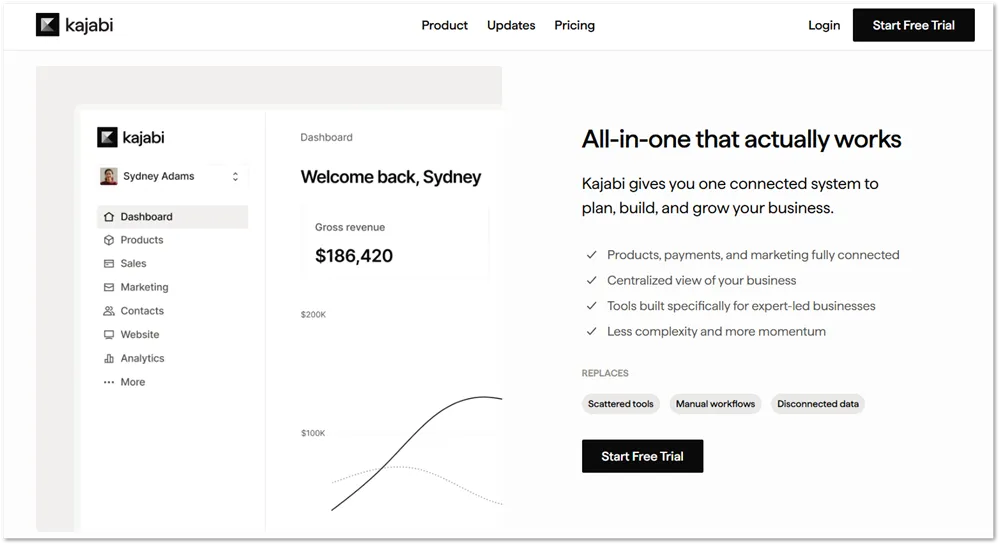
Kajabi is seriously one of the best course creation platforms available for creators who want to have everything in one place.
Their plans are built for scaling your business. Each plan has a limited amount of contacts and members you can manage as well as limits on how many products and pipelines you can create.
The platform lets you create different types of products from courses to podcasts and membership sites or you can offer coaching services. They boast that you don’t need integrations as they have everything built into their platform. External tools for CRM, email marketing and analytics aren’t necessary as you can do everything from your dashboard.
Prices for Kajabi start at $179/month (or $143 when billed annually) for the Basic plan and go to $499/month on their Pro plan. To get started, they give you a 14-day free trial of their most popular plan, the Growth plan. They do not offer a free plan.
In terms of support and education for creators, Kajabi has a lot to offer. With daily webinars that teach creators the ins and outs of using Kajabi as well as the Kajabi University, users have a lot of learning resources to master course creation using this platform.
There is also a private Facebook community for Kajabi users where you can get support, connect and create discussions with other creators.
Kajabi Pros
- all-in-one (no integrations needed)
- has more built-in tools than any other platform
- has an abundance of learning resources
- daily webinars for creators
- supports multiple product types
- can offer a range of payment plans
- plans allow you to scale as you need
- has 14-day free trial on all plans
Kajabi Cons
- no free plan
- plans are more expensive than Thinkific
- Some usage limits on lower tiers
- Less flexible if you prefer external tools
Kajabi is a very good platform for creators and they’ve been improving what they offer. While writing this blog post, they’ve made an update to the user interface which is a welcomed improvement.
There isn’t much to dislike although their landing page builder could use some improvements and unlike Thinkific, you cannot integrate the platform into your own website. The plans are more costly than those of Thinkific which may be a big deciding factor for some creators.
What is Thinkific?
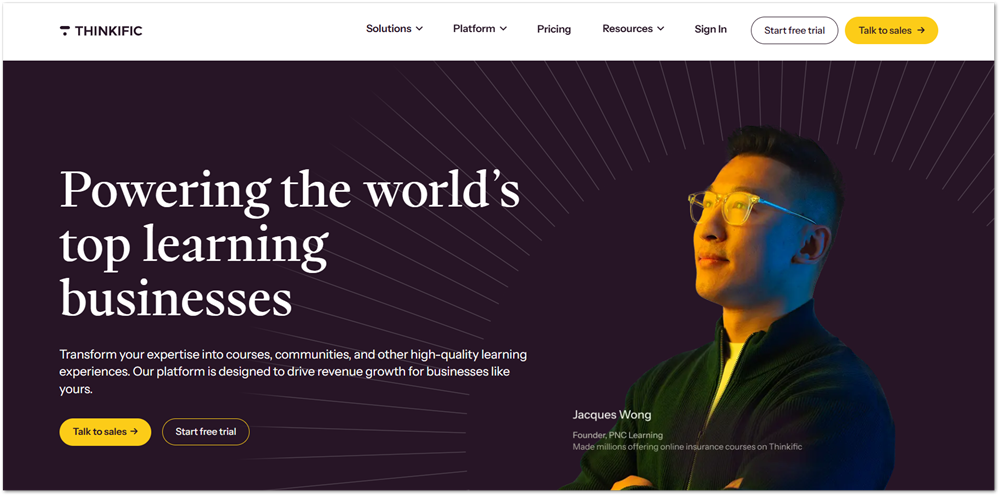
Thinkific is also one of the very best choices you can make when choosing a course creation platform.
Huge companies like Fiverr, Later and Hootsuite trust Thinkific and use its service to educate their customers. Even though Thinkific paid plans start at $49/month, they offer an enterprise-level service from their free plan right up to their Thinkific Plus plan.
The platform has everything you need to create and sell courses online. Though not all-in-one like Kajabi, there are many integrations available and some pretty great built-in features that make this a solid choice for course creators.
Paid plans begin around $49 per month when billed annually, with higher tiers adding features like communities, advanced customization, additional admins, and priority support.
Thinkific does not offer a permanent free plan. Access beyond the trial requires selecting a paid plan.
Thinkific’s support is also top-notch with a private Facebook community and support team that’s always ready to help. Thinkific Academy is where you can go to learn how to do everything from using the platform, building funnels, pricing your course, creating content, using Facebook ads, and more.
They have a very solid infrastructure in place for anyone who wants to create and sell their course online to do so and succeed.
Thinkific Pros
- start with a full 30-day free trial
- much lower starting price than Kajabi
- has an abundance of learning resources
- unlimited courses, students and content on all paid plans
- can integrate into your own existing website
- completion certificates included
- flexible plans allow you to scale as needed
- 80+ apps/integrations for more features
Thinkific Cons
- No built-in email marketing or funnels
- Requires integrations for advanced marketing
- Some features locked behind higher tiers
- no native blog tool
- Less “all-in-one” convenience
Kajabi vs Thinkific: Feature-by-Feature Comparison
Kajabi and Thinkific are two of the top choices you have when considering a course creation platform. There are other great alternatives but these two are unbeatable in what they offer when it comes to features, support, and education.
To help you compare them, I looked at some of the most important factors that could help you decide which one to go with.
Again, both platforms have free trials that you can use to test and help you decide on your own.
Here’s a breakdown of what Kajabi looks like against Thinkific.
Free Trial Length
Kajabi offers a 14-day free trial to test their platform. By default, you’ll be placed on the most popular plan, the Growth plan, but you can choose any plan to free trial if you go through the pricing page.
There is a way to extend your free trial and get up to 28 days free. Check out the Kajabi free trial page to see how.
Thinkific has a much longer trial of 30 days free. They let you try their most popular plan, the Pro plan but you can change your plan inside the dashboard once signed up. Like Kajabi, you can get an extended trial. Thinkific’s extended trial though is up to 2 months free. Check the Thinkific free trial page to see how.
Neither platform has a permanent free plan, so the trial period is the main opportunity to test each system risk-free.
Pricing and Value for Money
Pricing is one of the biggest differences between these two platforms.
Kajabi is positioned as a premium product. Its plans cost more, but they include tools that would otherwise require separate subscriptions, such as email marketing, automation, and sales funnels.
Plans start at $179/month ($143 if you choose annual billing) and this comes with some limitations. Each plan has a cap on how many products and pipelines you can create. You also have limits on the number of contacts and active members you can manage.
Thinkific starts at a lower monthly price and offers better value if you only need course hosting and student management. However, once you add third-party tools for email, funnels, or analytics, the total cost can increase.
Thinkific plans start at $49/month ($36 when you pay yearly) and go up to $199/month.
In short:
- Kajabi offers higher upfront costs with fewer external tools
- Thinkific offers lower entry costs with more flexibility
Integrations
Kajabi boasts that you do not need integrations because they’re an all-in-one platform that has everything you need to run your business. This may or may not matter depending on how you would like to run your business.
If you’d like to use Kajabi systems for your email marketing then it’s a good thing. If you’d rather have the flexibility of using your favorite email automation provider then you’d probably rather Thinkific.
Thinkific works a lot differently when it comes to integrations. They have an apps store where you can install apps made by the platform to integrate with essential services like Google Analytics and various email automation providers. You can also add lots of third-party apps that provide features that aren’t mentioned in any Thinkific feature list.
Both course platforms offer necessary integrations with Stripe and PayPal for payments.
Website Builder and Customization
Both platforms include a drag-and-drop website builder with responsive themes.
Kajabi requires you to build your site inside the platform. It works well, but you cannot embed Kajabi directly into an existing website.
Thinkific allows you to:
- Use its built-in site builder, or
- Integrate Thinkific into an existing website
This gives Thinkific an edge for creators who already have a website or want more control over their front end.
Kajabi lets you add a blog to your website which is missing natively on Thinkific. However, because the app store on Thinkific has so many integrations, you can use one called DropInBlog to add a blog to your website.
Education
Educating creators is a big part of retention for course platforms. Kajabi University and Thinkific Academy are the respective educational platforms for both of these services.
Both provide a solid education on how to use the service for creating and marketing courses and building a successful business.
I was more drawn to Kajabi’s offering because they have a daily webinar to help creators with different aspects of building their businesses and using the platform.
Course Creation
As two of the best course creation platforms, both services offer a great course creation experience and creators can do everything from offering coaching, scheduling courses, offering memberships, and more. With Kajabi you can offer podcasts which is something I haven’t seen with Thinkific.
Thinkific lets you offer completion certificates to students who have completed your courses. This is a great touch.
Marketing and Sales
Kajabi and Thinkific both let you manage affiliates who can help you sell your courses. You can also offer coupon codes or bundle your courses and offer flexible pricing.
Thinkific has order bumps on the order page so that you can sell more during the order process.
For Kajabi, everything is native which reduces setup time. Advanced marketing on Thinkific usually requires integration with external tools.
Kajabi vs Thinkific: Key Differences That Matter
If you’re still deciding between Kajabi and Thinkific, these are the differences that usually make the decision clear.
All-in-One Platform vs Modular Setup
The biggest difference is how each platform expects you to run your business.
Kajabi is built as an all-in-one system. Courses, email marketing, sales funnels, payments, and automation all live inside one dashboard. This reduces setup time and tool switching, but it also means less flexibility.
Thinkific takes a modular approach. It focuses on course delivery and lets you connect external tools for email, CRM, analytics, and marketing. This gives you more control, but requires more setup.
Choose Kajabi if you want simplicity. Choose Thinkific if you want flexibility.
Cost Structure and Scaling
Kajabi costs more upfront, but it replaces several tools you might otherwise pay for separately.
Thinkific starts cheaper, which is attractive for new creators. However, as you scale and add third-party tools, your overall costs can increase.
If you value predictable, bundled pricing, Kajabi makes sense. If you want to start lean and scale selectively, Thinkific is often the better fit.
Marketing vs Learning Features
Kajabi is marketing-first. Its built-in email campaigns, automations, and sales funnels are core to the platform.
Thinkific is learning-first. It includes features like completion certificates, structured course paths, and assessments that Kajabi lacks natively.
Your priority here matters more than any pricing table.
Website Control
Kajabi requires you to build your website inside its platform. While the builder is capable, you cannot deeply integrate Kajabi into an existing site.
Thinkific allows you to use your own website alongside the platform or rely entirely on its site builder.
If you already have a site or want maximum control over your front end, Thinkific has the advantage.
Long-Term Fit
Kajabi is ideal for creators building a single, unified business around their brand.
Thinkific works well for educators, teams, and businesses that want a dedicated learning platform that plugs into a broader system.
Neither platform is better for everyone, but one usually aligns better with how you plan to grow.
Is Kajabi or Thinkific Better in 2026?
In 2026, the better platform depends less on features and more on how you plan to run your business.
The online course space is more crowded, marketing costs are higher, and creators are expected to deliver a better student experience than ever. That makes platform fit more important than raw feature lists.
Kajabi is better in 2026 if you want speed and simplicity. Creators who want to launch quickly, manage everything in one place, and avoid juggling tools will benefit most from Kajabi’s all-in-one setup. It’s especially well suited for coaches, personal brands, and creators selling higher-priced programs where built-in marketing tools actually get used.
Thinkific is better in 2026 if your priority is course delivery and flexibility. If you already have an audience, a website, or existing marketing tools, Thinkific fits cleanly into that ecosystem. It’s also a strong choice for educators and businesses that care about structured learning, certificates, and long-term student access.
Neither platform is outdated or falling behind. They’ve simply doubled down on different philosophies.
If you want:
- Fewer tools and faster execution choose Kajabi
- More control and lower entry costs choose Thinkific
That distinction matters more now than it did a few years ago.
Conclusion – Try Kajabi or Thinkific (or both).
So which course creation platform is better – Kajabi or Thinkific?
Both platforms are really good and represent two of the very best in this industry. Personally, I love Thinkific because they offer a more affordable pricing, and their app store offers endless features. The longer free trial is another good reason to try them but free trials only last for so long.
Both are solid options for course creation features, marketing, and managing your students, contacts, and business in general.
You do not have to take my word for it. You can test both of these platforms with the free trials that they offer and then make your decision from there.
Check out the Kajabi page and see how to get an extended free trial and check out the Thinkific page to see how to get up to 2 months free.