If you’re looking for a platform to host your online community, Heartbeat is one of the more capable options out there right now.
I know because I’ve used it myself. I took the 14-day free trial a while back and built a community around the Trial Bear brand to see how the platform actually works in practice.
After coming back to the platform recently to see how things have evolved, this review reflects both that hands-on experience and where Heartbeat stands today. My goal is to give you a clear picture of what Heartbeat offers, what it costs, and whether it’s the right fit for what you’re trying to build.
This post may contain affiliate links. TrialBear earns commissions at no extra cost to you when purchases are made through links on this page. For more info, visit the disclosure page.
What Does Heartbeat Offer?
Heartbeat is built around the idea that you shouldn’t need five different tools to run an online community. Everything you need is available in one place. And that’s not just a marketing line because it actually holds up when you get inside the platform.
At the core is the community itself. Members get profiles, direct messaging, chat channels, and voice and video rooms that support up to 256 attendees. There’s also a member matchup feature that pairs people based on shared goals and interests, which is something you don’t see on a lot of competing platforms.
Courses are built natively into Heartbeat, so you don’t need a separate tool like Teachable or Kajabi to deliver structured content to your members. You can run evergreen courses, drip content on a schedule, or go cohort-based with fixed start and end dates. Video hosting is available as an add-on or included depending on your plan.
Events work the same way. No Zoom account is required if you don’t want one. You can host public or private events, set ticket prices, and send automatic reminders to boost attendance. Public event pages also work as a lead generation tool to pull people into your community.
On top of that, Heartbeat has workflows for automation, a documents feature for sharing resources and guides, and a payments system that handles memberships, one-time purchases, and even an affiliate program. The workflows alone can save a lot of manual work on things like welcome messages, access changes, and follow-ups which can all run automatically based on member actions.
There’s also Pulse, their built-in AI co-builder, which helps you set up your community, structure content, and handle behind-the-scenes tasks without needing to figure everything out on your own.
Apps are available for iOS, Android, and desktop, all with push notifications – which matters more than people realize when it comes to keeping members engaged.
Heartbeat Pricing
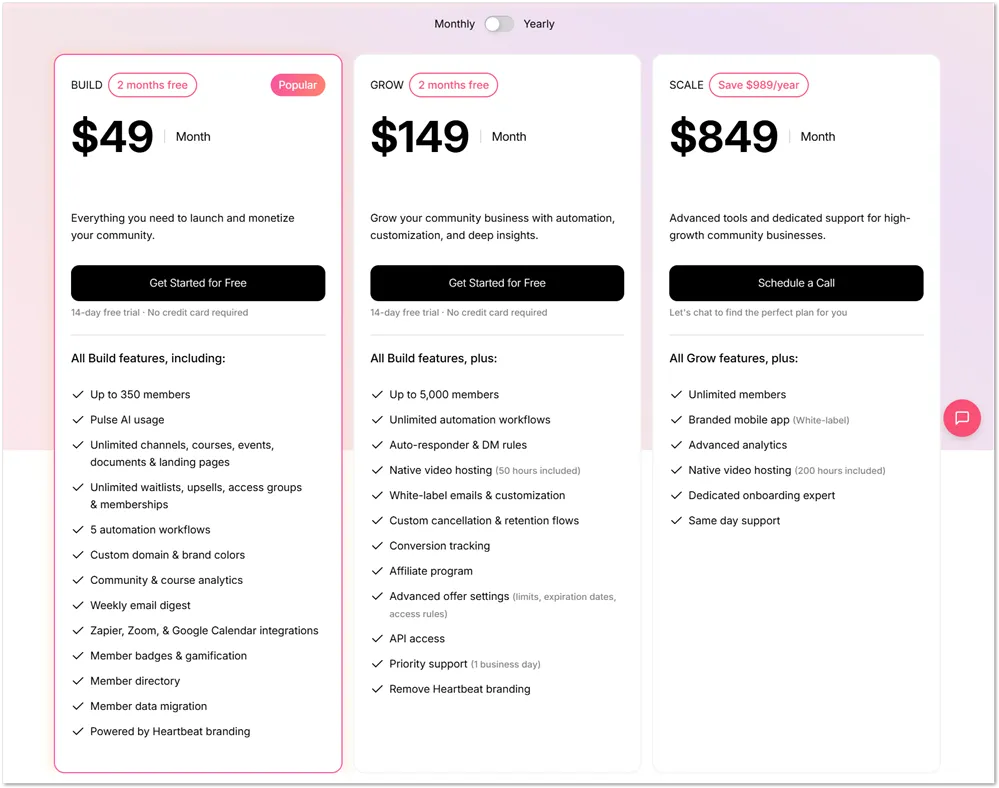
Heartbeat has three plans and a 14-day free trial that doesn’t require a credit card.
The Build plan costs $49/month (or $40/month billed annually) and is where most people will start. You get all the core features like courses, events, voice and video rooms, workflows, custom domain, and more.
With the cap on community member set to 350, I personally feel that this is too limiting but it might still be a great start for some. Transaction fees are 5% on top of Stripe’s standard processing fee.
The Grow plan is $149/month (or $124/month annually) and raises the member ceiling considerably to 5,000. It also adds meaningful features that aren’t on Build:
- unlimited automation workflows
- native video hosting
- white-label emails
- an affiliate program for your community
- API access
- and auto-responder rules.
Transaction fees drop to 2.5%. If you’re running a serious community business, this is the plan you’re building toward.
The Scale plan comes in at $849/month (or $766/month annually) and is built for high-growth operations. You get unlimited members, a branded mobile app, advanced analytics, 200 hours of native video hosting, and same-day support. Transaction fees drop further to 1.25%.
For most community builders just getting started, the decision comes down to either the Build or Grow plans. Build is a solid starting point, but it’s worth knowing upfront that some of the features you’ll eventually want, like the affiliate program and native video hosting, are sitting on the Grow plan.
Pros and Cons
What works well:
What to keep in mind:
Who Is Heartbeat Best For?
Heartbeat is a strong fit for coaches, course creators, and brand builders who want everything under one roof.
If you’re currently stitching together a course platform, a community tool, a Zoom account, and a payment processor, Heartbeat is worth a serious look because it replaces all of that.
It works particularly well for people who are building a paid membership community. The combination of courses, events, discussions, and payment tools means you can deliver real value to paying members without sending them to three different platforms to access what they paid for.
It’s also a good option if you’re migrating away from Facebook Groups. Heartbeat gives you a branded space you actually own, with better tools for monetization and member engagement than Facebook will ever offer.
Where it makes less sense is if you’re just starting out and have no audience yet. The platform is built for people who are ready to build and grow. If you’re still figuring out your niche or haven’t validated your community idea, you might be paying for more than you need right now.
Should You Use Heartbeat?
Heartbeat is a great option if you’re looking for a community platform in 2026.
The feature set is genuinely strong, the all-in-one approach holds up in practice, and the free trial gives you enough time to get a real feel for the platform before committing to anything.
The main thing to go in with clear eyes about is pricing. The Build plan is a reasonable entry point but has limitations that growing communities will run into. If you’re serious about building a community business, the Grow plan is where the platform really opens up, and the price reflects that.
That said, for coaches, course creators, and membership community builders who are ready to invest in a proper platform, Heartbeat delivers. It’s not the cheapest option out there but it’s one of the most complete.
The free trial is the obvious place to start. You don’t need a credit card and 14 days is enough time to set up your community, explore the features, and decide if it’s the right fit for your brand.